

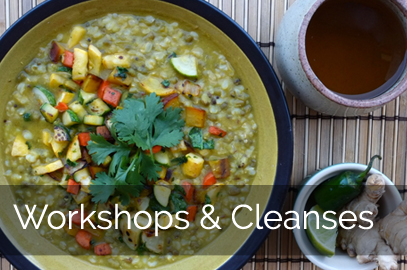
Miso Tahini Soup

This is a wonderful soup for a rainy winter day, or any day for that matter – as it’s fresh and light but warming on the inside.  The bonus is that it only takes about 10-15 minutes to make and requires just one pot!   The vegetables can all be substituted for whatever’s in season and preferred.

Serves 3-4

2-3 Quarts Water
1 Sweet Potato (medium)
2 Carrots
1 C Broccoli Crowns
2 tsp Fresh Ginger (grated)
1 tsp Lemon Rind (grated)
1 tsp Crushed Red Chile Pepper (optional)
1 C Kale (chopped)
1 Package Udon or Soba noodles (8 oz)
1 Lemon (juiced)
2 T Miso Paste (e.g. brown rice, yellow or red miso are all great)
1 T Apple Cider Vinegar
1 T Nama Shoyu or Soy Sauce
1 T Tahini

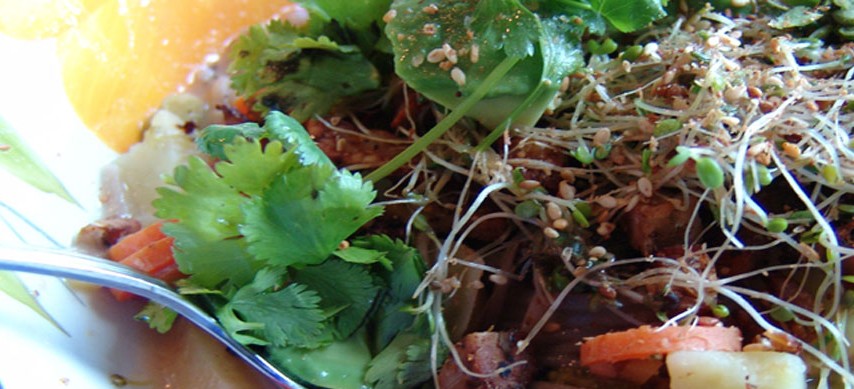
Chop sweet potato into approximately 1/2 inch squares, chop broccoli and dice carrots to similar size.  Add water, sweet potato, carrots and ginger to large soup pot and bring to boil with lid on.  Reduce heat to medium.  Add broccoli, lemon rind, red pepper and kale and continue to cook for approximate 2-3 minutes with lid off.  Add udon noodles and stir with fork to separate.  Add chopped kale and stir well. Cook for additional 4-5 minutes (until noodles are tender).  Mix all remaining ingredients together in a small bowl.  When udon noodles are tender, turn heat to low and add miso mix. Stir well and remove pot from stove.  Serve warm and garnish with any or all of the following: fresh cilantro, sprouts, gomasio or roasted sesame seeds, and/or avocado slices.

Also great with Ground Round Tempeh or Thai Tofu, which adds some healthy protein.

Or, try substituting quinoa for the udon. Simply make 1 cup of quinoa in a separate pot (1 C quinoa, 2 C water: bring water to boil, add quinoa, turn to low and cook with lid on for approximately 12-15 minutes).  Add the prepared quinoa to the soup when adding the miso mix.


The Art and Heart of Ayurveda

Ayurveda is said to be the mother of all holistic medical systems. The word Ayurveda literally means “the wisdom of life.” (in sanskrit, Ayu = life or long-life, and Veda = system of science or wisdom). While Ayurveda is rooted in ancient India, its principles can be applied to all places, cultures and all times. In fact, the answer to almost any question in Ayurveda is “it depends” – on the person, the environment, the place, the time, etc. etc… The beauty and effectiveness of Ayurveda is that it is so individualized. Indeed, Ayurveda is as much a path toward expressing our true nature as it is a system of medicine. To use the words of Maya Tiwari – a devoted Ayurvedic practitioner, author and chef – Ayurveda’s principles with respect to eating and daily routines help us to “remember our being.”

Most people familiar with Ayurveda associate it with the concept of the doshas or the mind/body constitutions of Vata, Pitta and Kapha. But what do these words really mean? Or, more significantly, what does it mean to say that you are, for example, “a Vata.” Let’s take a step back.

According to Ayurveda, all matter in the universe, including our physical body and the food we eat, is comprised of a unique combination of the five great elements – ether, air, fire, water and earth. These elements are not matter but are different types of energy that work with one another in a state of constant interaction. In turn, they are responsible for: creating (ether), moving (air), transforming (fire), lubricating (water) and stabilizing (earth), all things.

We all have some idea of what these elements mean, or can at least describe them, aside from perhaps the more esoteric “ether.” The easiest way for me to understand ether is that it is the space through which air moves. It is nothingness, or the potential for creation. As for the others, air is like a windy day – cold and dry. Fire is obviously hot. Water can be associated with moist, cold, even oily. Finally, words to describe earth are dense, solid, and heavy.

So here’s the key: the doshas are linked to these elements. Vata is ether and air, Pitta is fire and water, and Kapha is water and earth. To say, for example, that you are a Vata means that you have more of the air and ether energies working within you, and therefore your tendencies for imbalance – or “disease” – will likely be attributable to the qualities of cold and dry (e.g. constipation, achy joints, arthritis, osteoporosis). Again, just as our physical bodies are comprised of these elements, so too is our food. So now what? The key rule in Ayruveda is that “like increases like and opposites decrease each other.” Thus, if you are feeling cold and dry, or suffering from conditions associated with these qualities, you can alleviate the root cause by changing your diet and/or lifestyle so as to build heat and lubrication within. For example, by eating warming soups and stews with adequate servings of oil, nuts and seeds, versus eating cold and dry salads or vegetables; wearing adequate clothing to minimize your exposure to cold and windy environments; and/or being sure to apply natural oils or lotions to help lubricate your skin and joints.

The real heart of Ayurveda is well beyond this gross level of the elements and the doshas. According to Ayurveda, all disease is a consequence of disharmony and imbalance. Thus, health is an ongoing process to maintain a dynamic harmony and balance in all aspects of life – including physical, emotional, mental and spiritual. By using these concepts we can learn more about ourselves, our food and our environment. We can begin to balance, integrate and express the true nature of our beingness, which in turn will help cultivate optimal health for ourselves, others and our planet.


Autumn Goodness Bars

Makes 8 large bars (2″ x 4″)

The nourishing oils of the almonds and seeds and the energizing sweetness of the dried fruit and maple syrup are perfect to ground you amidst the wind, cold and dryness of the autumn months.

1 Cup Large-Flake Oats
1 Cup Oat Flour*
1/4 Cup Whole Flax Seeds
1/4 Cup Whole Sesame Seeds
1/4 Cup Chopped Almonds
½ Cup Chopped Dried Fruit (e.g. raisins, apples, cherries, apricots, etc)
1/4 tsp. Grated Orange Rind (optional)
1/8 tsp. Ground Cinnamon
1/8 tsp. Ground Ginger
1/4 tsp. Sea Salt
½ Cup Maple Syrup
1/4 Cup Apple Juice/Cider
1/4 Cup Almond (or Sesame Oil)
1/4 Cup Almond Butter

Preheat oven to 350 F. Combine and stir together all dry ingredients in large bowl. Combine wet ingredients in separate bowl and stir until creamy. Slowly pour into dry ingredients and stir until all ingredients are thoroughly mixed. Press into baking pan (ideally 9″ x 9″) or equivalent pie pan. Bake 15 minutes. Remove from oven and leave to cool completely in before cutting and wrapping.

* You can simply make oat flour by grinding oat flakes in a coffee grinder.


Citrusy Adzuki Stew

The fall is associated with the Vata energies of air and ether, as indeed it can be described as windy, cold and dry. Thus, we can all benefit from foods that are grounding, warming and lubricating. This adzuki bean stew is perfect for an early fall evening, as it complements the use of fresh summer greens and citrus with grounding root vegetables and legumes, warming herbs and spices, and lubricating nut/seed butter.

Serves 4

5-6 Cups water
¾ Cup Adzuki Beans
1 Cup Quinoa
2 Carrots
1 Medium Sweet Potato
1 Cup Winter Squash (e.g. pumpkin, butternut squash)
1 Cup Kale, Collards and/or Chard
1 T grated ginger
2 tsp. ground cumin
2 tsp. ground coriander
1 tsp. cinnamon
1 tsp. dried basil
1 tsp. dried thyme
1 tsp. dried oregano
1 T orange/grapefruit rind
2 medium oranges or grapefruits (juiced)
1 T Maple Syrup
1 T Apple Cider Vinegar
2 T Tahini or Almond Butter
1-2 tsp. Sea or Rock Salt
Pepper to taste
Fresh Cilantro to garnish

Soak adzuki beans overnight (as it will both shorten cooking time and also help to activate enzymes that aid in digestion). Drain and rinse well. Add adzuki beans and water in large pot and bring to boil. Turn heat to medium/low and cook with lid on. In about 30-45 minutes (once beans are pretty well cooked), add carrots, sweet potato, and winter squash, quinoa and ginger. Add an additional 2 Cups of water and bring to boil. Cook on low heat with lid on for another 20-25 minutes, until vegetables and quinoa begin to soften (you may need to gradually add more water). Add remaining ingredients – except salt, pepper and cilantro – and stir well. Cook on low for another 10 minutes, again adding more water for desired consistency. Add salt and pepper just prior to serving. Garnish with fresh cilantro.


Crimson Quinoa & Greens

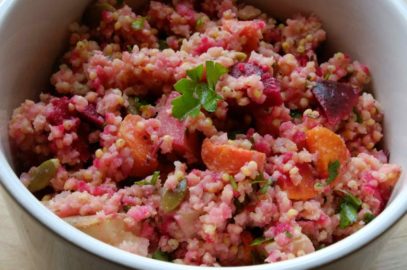
I love the combination of quinoa and beets, as the quinoa takes on the bright red color. This dish is a great served on its own, or as a side dish – super for summer picnics and BBQs.

Preparation time: 30-40 minutes.
Serves 3-4
 
3 Beets
2 C Water
1 C Quinoa
2 tsp. Grapefruit Rind, minced
1 T Fresh Ginger, grated
1 C Chard, chopped
1 Grapefruit, juiced (or 1/2 C Grapefruit Juice)
1 T Apple Cider Vinegar
1 T Agave Nectar
1-2 T Olive Oil
2 tsp. Rock or Sea Salt
1 T. Cumin Seeds
1/4 C Sunflower Seeds
1 C Arugula, chopped

Chop beets into 1/4-1/2” cubes. Add water, quinoa, beets, grapefruit rind and ginger to medium pot or sauce pan (with lid).  Bring to boil.  Reduce heat to low and add chopped chard.  Cook with lid on for 15 minutes. Meanwhile, place grapefruit juice, apple cider vinegar, agave nectar, olive oil and salt in blender (or in large bowl) and blend/stir until mixed well. Dry roast cumin seeds and sunflower seeds in small pan until lightly browned. When quinoa is cooked (all water is absorbed), take off stove and let cool for about 5-10 minutes.  Add grapefruit sauce, seeds and arugula to quinoa and fluff lightly with a fork.  Serve warm or cool.


A Climate-Friendly Diet

Food activist and writer Anna Lappe offers 7 insightful principles for food our choices, which if we all abided by could positively impact our planet. Read article here.  Also check out her new book “Diet for a Hot Planet: The Climate Crisis at the End of Your Fork


Beets, Chards

Beta vulgaris

Beets and Chards are chenopods, a sub family of the amaranthaceae family (which also has spinach, quinoa, and amaranth).1. So I figured I’d group them together here.

Beets were first cultivated by the ancient Romans, and were popularized when Napoleon declared them to be used as the primary source of sugar when the British restricted access to sugarcane.2. The beetroot is indeed quite sweet, but the fact it is high in fiber makes it low on the glycemic load (i.e. it won’t shoot your blood sugar levels up and down). While we in the west most commonly eat the colorful beetroot, the beet greens are higher in nutritional value; they are richer in calcium, iron and vitamins A and C. Nevertheless, the roots are a great source of folic acid, fiber, manganese and potassium and have long been recognized for their benefit to the liver and the body’s detoxification process. 3 Beet roots are also gaining recognition for their reported anticancer properties, as the pigment that gives them their rich purpose-reddish color (betacyanin) is a powerful cancer-fighting agent.4.  They are known in Ayurveda to help with blood disorders.

Chard is often referred to as “Swiss Chard” here in the U.S.; a name which was used  to distinguish it from French spinach varieties by 19th century seed catalog publishers5. The funny thing is that from my experience people in Switzerland have no idea what you’re talking about when you say “Swiss Chard”.  We in the U.S. again tend to be a bit too particular about which parts of chard we eat by generally eating just the greens.6.  My husband and I worked on a farm in the south of France with a sagacious frenchwomen Marie.  Marie cooked us a wonderful soup the first night, and I was astonished to observe her peeling off all the greens of the freshly picked chard and throwing them in the compost – while chopping and adding just the stocks to the pot! But it was delicious, and surprisingly tender. I’ve since enjoyed cooking the stalks of the rainbow chard varieties (but opt to throw in the greens as well), as they add a wonderful array of colors to any dish. You definitely need to cook the stalks quite a bit (i.e. they take about the same time to cook as beetroot), and even so they won’t be meltingly tender like spinach.   As for its nutritional value, swiss chard is an excellent source of carotenes, vitamins C, E and K (good for bones), dietary fiber and chlorophyll and it’s a good source of minerals like magnesium, potassium, iron and manganese.7.  Like beets, chard is also considered a powerful anticancer food, and in particular it has performed well in several research studies focusing on digestive tract cancers.8.

Beetroots, beetgreens, chard greens and chard stalks are all edible and nutritious, and they are a great way to add some colorful delight to vegetable dishes, pilafs, soups, salads or just about anything.

  1. Wikipedia – Amaranthaceae []
  2. Murray, Michael. The Encyclopedia of Healing Foods (2005), 165 []
  3. Murray, 165 []
  4. Murray, 165 []
  5. Wikipedia, Chard []
  6. National Geographic, Edible: An Illustrated Guide to the World’s Food Plants (2008), 167 []
  7. Murray, 239 []
  8. Murray, 239 []

Ground Round Tempeh

Looks aren’t so deceiving. Tempeh not just looks like meat, but in my opinion has an even better way of taking on the flavors of seasonings.  So you won’t be missing out by substituting this healthy vegan “meat” option for tacos, pasta, soups, etc.  Just add whatever marinade that matches the cuisine (see examples below).

1 8 oz. package of tempeh
4 T marinade

Turn oven to broil.  Slice tempeh into small pieces, place in bowl and crumble further with fingers.   Add marinade and mix well. Spread into flat oven-safe baking dish so that tempeh is no more than 1/2 inch thick.  Place in oven and cook for approximately 5 minutes.  Stir well and cook for additional 3-5 minutes (depending on strength of broiler).  Remove from oven and add to your favorite dish!

Here are some examples of marinades:

Sweet-Thai Seasoning (great with Tahini Miso Soup)

2 T Nama Shoyu or Soy Sauce
1 T Agave Nectar
1 T Apple Cider Vinegar
1-2 tsp. of mixed herbs & spices (e.g. including fresh ground pepper, star anise, ground coriander, basil, and/or crushed red pepper)

Italian-Seasoning (great with Pasta Pesto)

1 T dijon mustard
1 T agave nectar
2 T Apple Cider Vinegar or Balsamic Vinegar
1-2 tsp of mixed savory herbs (basil, thyme, oregano, marjoram, rosemary, sage, etc.)

Mexicali- Seasoning

2 T Lime Juice
1 T Apple Cider Vinegar
1 T Agave Nectar
1-2 tsp. of mixed herbs & spices (e.g. cumin, black pepper, paprika, coriander, oregano)


Quinoa: the “Mother Grain”

Quinoa was known by the Incas as “the Mother Grain.”  It’s no wonder, as it’s full of nourishment.  The nutritional quality of quinoa has been compared to that of dried whole milk by the Food and Agriculture Organization (FAO) of the United Nations.1.  Quinoa is considered a complete protein as it contains all eight of the essential amino acids that are required by the human body to aid digestion.  It also has a high content of unsaturated fats to provide sustenance and has fewer carbs than most grains so it won’t weigh us down. 2.  Yet another benefit is that quinoa is a gluten free grain.  In fact, quinoa is not a true cereal as it is not a member of the grass family (Poceae). Rather it grows as a plant that resembles spinach with clusters of small seeds on the stems. When hulled and dried, these seeds are what we know of as quinoa. 3 .

Quinoa is very versatile when cooking, and offers a perfect substitute for the typical gluttonous or high-carb grains. It has a slightly nutty flavor which complements both sweet and savory dishes.  It can be added to soups and stews (e.g. Miso Tahini Soup), ground into a flour for gluten-free baking and offers a perfect substitute for processed grains like cous cous or bulgur (same ratio – 2 parts water: 1 part quinoa). Quinoa is considered to be balancing to all body-mind types, but is particularly good for the vata types that benefit from easily digestible proteins.

Most quinoa purchased in North America is currently imported from South America. But there is hope of growing it in the U.S.. Field trials and research on developing quinoa as a crop here is being conducted in Colorado.  Results show that there is potential to grow quinoa in southern Colorado, northern New Mexico and Eastern Washington. 4.  So let’s do our part in driving the market for locally grown quinoa!

  1. http://www.hort.purdue.edu/newcrop/afcm/quinoa.html []
  2. Edible, An Illustrated Guide to the World’s Food Plants. National Geographic (2008), 218 []
  3. Edible, An Illustrated Guide to the World’s Food Plants. National Geographic (2008), 218 []
  4. http://www.hort.purdue.edu/newcrop/afcm/quinoa.html []

The Six Tastes

Ayurveda describes food based on the Six Tastes – or Rasa. These  reflect a combination of the five great elements – Sweet (Earth + Water), Sour (Fire + Earth), Salty (Water + Fire), Pungent (Fire + Air), Astringent (Air + Earth), and Bitter (Air + Ether). The action and function of each of the Six Tastes is because of its unique elemental composition. To maintain balance in the body and mind, all Six Tastes need to be consumed in the right proportion for your body-mind type.  In short – Vatas are best to maximize sweet, sour and salty tastes and minimize pungent, astringent and bitter.  Pittas are best to maximize sweet, astringent and bitter and minimize sour, salty and pungent. Kaphas are best to maximize pungent, astringent and bitter and to minimize sweet, sour and salty.  [For more on this concept see posting on The Five Elements - Balancing the Mind/Body with Food].

Sweet (Earth + Water)
Sweet foods include complex carbohydrates, sweet fruits, all grains (e.g. rice, pasta, oatmeal, wheat), root vegetables, sugar (avoid processed sugar), honey, milk, certain cheeses, and oils. They strengthen the tissues in the body, improve circulation, and strengthen the heart. Their qualities are heavy, oily, and cold. Sweet foods give the mind a sense of compassion and satisfaction. However, eating too many sweet foods can lead to lethargy and obesity.

Sour (Fire + Earth)
Sour foods include yogurt, lime, sour fruits, vinegar,  and some cheeses. They improve digestion, stimulate acid secretions in the stomach, reduce gas, and increase circulation. Their qualities are light, oily, and hot. Sour foods provide the mind a sense of stimulation and clarity in discernment. However, eating too many sour foods can lead to ulcers and infections.

Salty (Fire + Water)
Salty foods include sea salt and rock salt. They make food tasty, strengthen and improve digestion, calm the nerves, help the body retain water, and maintain electrolyte balance.  Their qualities are heavy, oily, and hot. Salty foods provide the mind a sense of confidence and zest for life. However, too many salty foods can cause physical ailments such as hypertension and kidney stones.

Pungent (Fire + Air)
Pungent foods include ginger, black pepper, chile peppers, jalapenos, cayenne, and garlic. Eating the right amount of pungent foods can help improve metabolism, help digestion and absorption, reduce congestion, improve circulation, and promote sweating. Pungent foods have light and dry qualities. Pungent foods can help one to be clear, outspoken, and bold with his or her thoughts. However, too many pungent foods can lead one to over-heat physically and mentally, and turn to anger and hatred.

Astringent (Air + Earth)
Astringent foods include cranberries, beans, soy, the peel of a fruit, cranberries, and turmeric. They promote healing, help constrict blood vessels, and stop bleeding. Their qualities are heavy, dry, and cold. Astringent foods can lead one to go inward with his or her thoughts. Too many astringent foods can cause insomnia, low blood pressure, and anemia.

Bitter (Air + Ether)
Bitter foods include green leafy vegetables (e.g. chard, collard greens, kale, arugula, spinach), aloe vera, and bitter melon. They help purify/detoxify the blood and improve the tissues in the body. Their qualities are light, dry, and cold. Too few bitter foods can cause an accumulation of toxins in the body, but too many bitter foods can cause constipation and tissue depletion.


Get Feeds
Subscribe
Savor the Elements
To learn more about Erin's cooking workshops in the Spokane, WA area, or to purchase her organic spice blends visit her site at www.savortheelements.com
Food Policies